
How Robotic Palletizing Systems Work: A Technical Breakdown
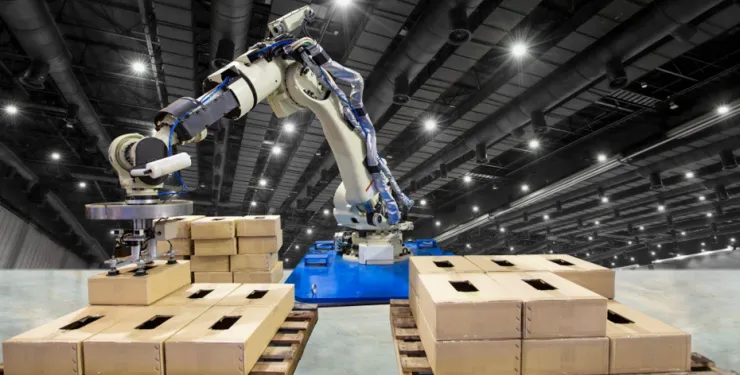
Robotic palletizing has become common in manufacturing and warehousing, contributing to a growing demand for robotics technicians in automated production and warehouse environments. To complete their jobs, robotics technicians must understand robotic motion systems, programming logic, and automation controls. If you're seeking a career in robotics in Canada or the United States, training aimed at adult learners can help prepare you to work with robotic palletizing systems.
Key Takeaways:
- Robotic palletizing systems stack products onto pallets with speed and precision.
- Robotics technicians play a role in configuring, maintaining, and programming palletizing systems.
- Robotic palletizers rely on vision systems, sensors, and PLCs to coordinate their operations.
- Robotics technicians must understand the motion control and communication systems that enable robotic palletizers to do their work.
- Technicians must also be proficient in maintenance, troubleshooting, and diagnostics of robotic palletizing systems.
What Is a Robotic Palletizing System?
A robotic palletizing system is an industrial robot that can load and stack products on pallets. These systems are commonly used in manufacturing, logistics, and distribution centers. Robotic palletizers are highly flexible and can respond to changing conditions with relative ease. When speed is important, the use of multiple robots can help increase their speed and effectiveness. They're highly space-efficient and energy-efficient, so they're a great investment for many businesses. Best of all, robotic palletizers have advanced safety features that make them safe to operate near human workers.
Difference Between Robotic and Conventional Palletizers
While robotic palletizing systems may be somewhat of a recent innovation, it should be noted that conventional palletizers have been in use for many years. Conventional palletizers are mechanical systems that automatically pack pallets and stack them with accuracy and precision. These palletizers are efficient, high-speed, and cost-effective for many companies.
The primary difference between robotic palletizing systems and conventional palletizers is the lack of flexibility offered by conventional systems when product changes or modifications occur. They can be useful and cost-effective in certain environments, but they're challenging and expensive to reconfigure. Conventional palletizers are best suited for repetitive tasks that are not expected to change.
How Robotic Palletizing Systems Work Step by Step
This is how a robotic palletizer works:
- Items arrive on a conveyor belt.
- Robotic sensors detect the items.
- The robotic arm picks up the item.
- The item is placed onto the pallet in a pattern that is efficient for the items being palletized.
- The process is repeated until the pallet layer is complete.
- This process is repeated in another layer.
- Layers continue to stack until the pallet is full.
Robotic palletizers stack products according to programmed patterns, and then the completed pallets are transferred for shipping or storage. This process repeats continuously as needed.
How Programming Affects the Procedure
Robotic palletizers rely on precise settings to stack products correctly.
- Product dimensions: The robot must know the exact product dimensions, including length, width, and height. Incorrect dimensions can cause collisions or poor stacking.
- Pallet dimensions: The system must know the size of the pallet, as this affects how many products will fit on each layer.
- Product weight: The weight of a product affects how it is stacked and the robot's speed.
- Spacing: The robot must know whether small gaps between products are required, and if so, how wide.
- Layer patterns: The pattern of the layer affects the stability of the pallet. Patterns may be interlocking, brick-style, straight columns, etc. The layer pattern helps keep the pallet secure, stable, and balanced during shipping. A good layer helps distribute weight and prevents the pallet from falling apart.
Main Components of Robotic Palletizing Systems
A robotics technician must become familiar with the many parts of a robotic palletizing system, including:
- Robotic arm: This is the part of the robot that picks up and places products on the pallet.
- Gripper: This is the robot's "hand," which may use suction cups or forks to grip objects and place them on the pallet.
- Sensor: Sensors help the robot detect the product's position.
- Programmable Logic Controller (PLC): This is an industrial computer that helps coordinate the system.
Understanding Robotic Programming Logic
Robotic programming logic is the instruction list that tells the robot what to do, like where to pick up and place items, and which stacking pattern to follow. Robotics technicians must understand the basics of robot programming in palletizing applications so they can coordinate the systems, implement pick-and-place programming sequences, help the robot avoid collisions, and troubleshoot robotic palletizers that experience problems.
The Role of the Robotics Technician
Robotics technicians program robots, troubleshoot errors, adjust system settings, and help ensure the overall safe operation of palletizing robots. By testing pallet patterns, maintaining sensors and mechanical parts, and by diagnosing and addressing errors, robotics technicians keep palletizing robots functioning smoothly and efficiently.
Common Robotic Palletizing Faults and Troubleshooting
Robotics technicians use preventative maintenance procedures to identify alignment errors, sensor communication failures, and errors in calibration. Palletizing robots need regular inspection, cleaning, lubrication, and re-calibration to continue to stack pallets properly. In addition to solving problems, robotics technicians also reduce downtime by taking a proactive approach to maintenance.
Start Your Career With Robotics Technician Training
The future is bright for robotics technicians. If you're interested in industrial robotics and want to get started as a Robotics Technician, or if you're already in the field and want to advance your career, enroll in a program that specializes in adult learning. A quality certificate program will help you enter this exciting field. Contact us at 1-888-553-5333 to speak to one of our Program Consultants and to learn about our Robotics Technician Training Program today.